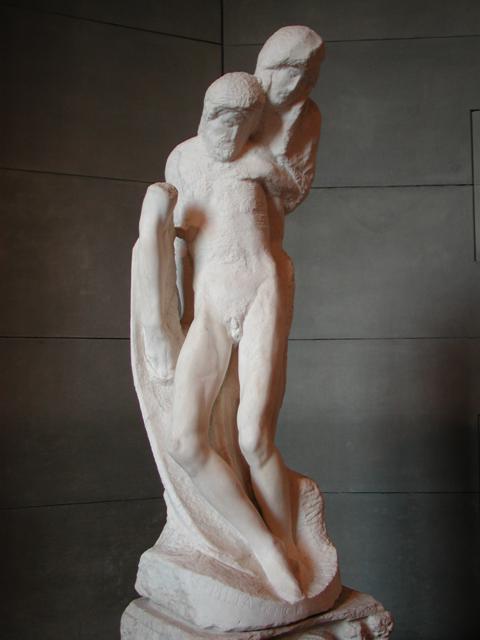
A Mester, akit leginkább a Sixtus-i kápolna freskójáról, Dávid monumentális szobráról, a fájdalmasan szépséges, végletekig kidolgozott Piétá-járól ismernek, élete legvégén befejezetlenül hagyta azt a művét, melyen tizenkét év munka után is látszik a bizonytalanság, a gyötrődés, a kétely. A Mester, akinek aprólékossága vlt a védjegye, aki az emberi test minden kis zugát, ráncát, a múlékony húsra boruló ruha minden sóhaját kifaragta a gigászi márványtömbökből, a Mester élete végén megtagadta addigi munkásságát, hogy egyetlen gyötrő gondolatot fejezzen ki a korábban oly nagyra tartott szépség teljes mértékű mellőzésével.
Hogyan jut el egy, már életében is elismert, világraszóló művész a siker csúcsától az önmegtagadásig? Miként csupaszítja le önnön fellengzős, esztétikailag káprázatos stílusát egy olyan alkotás kedvéért, melynek tartalma, bár hasonló egy korábban (1499-ben) kifaragottéhoz, az egyszerű forma hatására teljes mértékben eltér elődjéétől? A Piéta mai napig emberek millióinak jelent közös zarándoklati pontot; fél évszázaddal később Michelangelo létrehozta azt a szobrot, mely a Krisztus alakjára boruló Máriát ábrázolja, és mely a durva vonalak és a díszítések teljes hiányának segítségével a művész múlandóságát és ébredező spiritualitását volt hívatott kifejezni.
Ő meglátta az üzenet fontosságát, és hajlandó volt levetni magáról minden sallangot, minden cicomát annak érdekében, hogy kifejezhesse azt. Vajon én eljutok-e életem végéig oda, ahova ez a szeretetéhes, dölyfös ember a művészet magányában töltött évek múlva eljutott?


8 Comments
I’m very interested in this. The Pieta. And is the second piece Michaelangelo’s too? Unfinished? What did you write?
You remember I translated that movie about Michelangelo’s life? It started with a brief documentary introduction on his work. They spoke about his last, unfinished work, the “Rondanini Pieta” that he worked on for the last 12 years of his life, and never finished it. It struck me how very detailed he was in the beginning, how chiselled, how aesthetically pleasing- to finally arrive, at the twilight of his earthly life, to a stage of growing spirituality and a negation of all his former ideas. basically he stripped himself of the pretence of beauty to express much more lasting values: depth, spirituality, suffering. Each time I think about this I marvel at how that man whose most famous works are about details, arrived to that final piece of almost bland imagery to express a message he found important. I wrote about this and I wondered if I was ever to arrive at that moment…
Btw isn’t it strange that his last piece is the one he worked on for the longest time, it was probably the most important for him, and yet we hardly know about it? All my life I associated him with the Sixtine chapel and David and the Pieta… I only heard about the Rondanini Pieta a few months ago.
Also, there are speculations about the two figures, that of Christ and that of Mary. At first glance, it looks like Mary’s leaning over Christ, moruning him. From another angle, it looks as if Chris was sustaining the moruning Mary through the power of his spirit. They say Michelangelo made the sculpture that way on purpose, to express the ambiguity of the situation.
Fascinating, right?
If not for the idealised style of the thighs and legs, I wouldn’t have recognised that it is Michaelangelo’s work. Maybe he did the lower part that way as a statement that it was “his work” even if he was veering away from his style. And I thought that the person at the back was Christ, not Mary. And the man in front was someone else he was comforting/supporting. Hmm. Certainly ambiguous. I think they are leaning into each other – so they are mutually sustaining each other.
I also had some thoughts about what you said – working in detail. The journey through life must be like working on a huge puzzle. We are given little pieces at a time: the detail. And we have to look at each piece very carefully – the shape, the hue, the content and find out what its orientation and location in the big puzzle should be. And slowly the pieces start fitting together. Sometimes there’s a “key” piece that unlocks a big part of the puzzle so that it starts to make sense. When the big picture starts to make sense, then it is the “big picture” which becomes the guide for determining where the remaining little pieces should go.
I don’t think the final image will ever be “bland”. It will be as rich as all the little pieces that have gone into making it. But yes, the sum will be bigger that its parts, and sometimes to convey the bigger, more profound concept, the details have to diminish. We are only human after all – we either look at something up close or from afar. God on the other hand, will see everything in its entirety and minuteness.
You’re right, Mary looks almost masculine, but in all truth, both human figures look almost androgynous. Like humans are meant to be, after all.
And they both sustain each other, yes. He worked on it for twelve years but he sure made a point!
About your other comment, seeing first the details and then the big picture, I agree with you, life is like that, if we’re lucky and if we’re wise enough to see the big picture. Not everyone does.
I think I understand more what Zen wisdom is about: forget the flourish, just look at the real meaning. But also, they take the tiniest detail, like a pebble, or a flower, and project the whole universe onto and into it, because they say that everything and everyone is a microcosmic counterpart of our endless universe.
I never looked at it the way you reminded me to- thanks, sis! *hug*
“…see a world in a grain of sand…” That kind of thing.
YOU do. *hug*
Nagyon szép írás!